
Convection Oven: How It Works and How to Choose One for a Bakery
A practical guide to fan-driven baking, product fit, tray capacity, steam, controls, utilities and the questions professional buyers should answer before requesting a quotation.
Last reviewed: September 2026
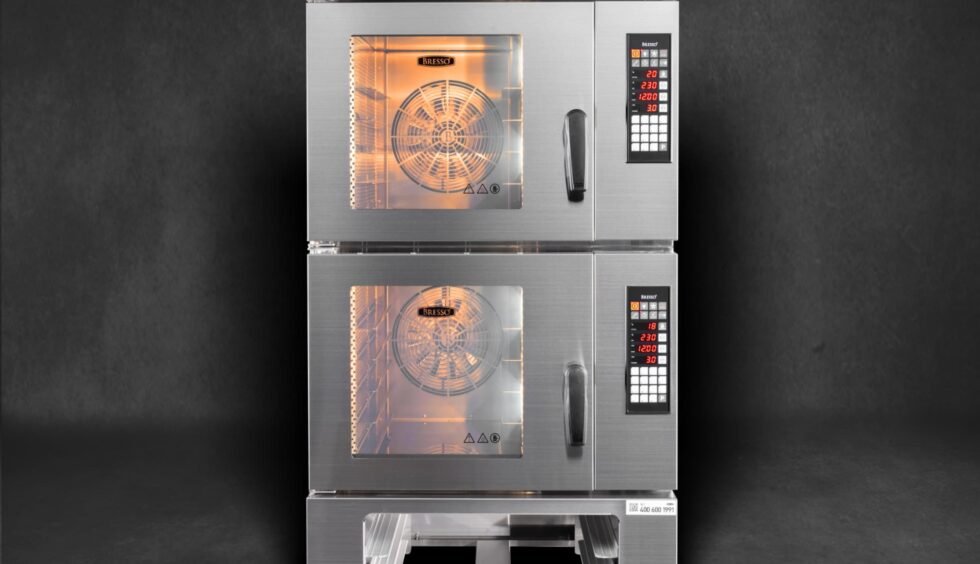
What is a convection oven?
A convection oven uses a fan to move heated air through the oven chamber and around the food. In commercial baking, that moving air can improve heat transfer across multiple trays and support repeatable color when the oven, loading pattern and recipe are correctly matched.
It is not automatically the right oven for every bakery product. Strong airflow may suit cookies, rolls, pies and many laminated products, while delicate batters or breads that depend on concentrated deck heat may call for different fan settings or a deck oven. Professional selection begins with the product, not the oven label.
This article focuses on professional bakery production rather than domestic wall ovens or countertop air fryers. The operating principle is related, but commercial buyers must also consider tray standards, batch flow, electrical load, water, drainage, ventilation, installation access and destination-market requirements.
How does a convection oven work?
A conventional static oven heats primarily through radiant heat from the elements or burner system, natural air movement and heat conducted through pans or a baking surface. A convection oven adds mechanical air movement. Its fan draws or pushes air through a designed path, passes that air across the heat source, and redistributes it around the loaded chamber.
Heat generationElectric elements or another specified heat source raise the temperature of the circulating air.
Fan circulationThe fan moves hot air through the chamber; baffles and chamber geometry influence the path.
Heat transferMoving air contacts exposed product surfaces and trays, increasing convective heat transfer.
Control responseTemperature sensing and the control system cycle or modulate heat to follow the set baking profile.
The fan alone does not guarantee uniform baking. Air velocity, fan direction, tray spacing, the amount of product on each tray, pan shape, door sealing and the position of the temperature sensor all affect results. An overloaded tray can block airflow; an under-loaded test may look excellent but fail to represent daily production. For that reason, a buyer should evaluate the oven with the intended product and loading pattern whenever practical.
Why reversible airflow matters
Some commercial bakery convection ovens reverse fan direction during the cycle. Reversal is intended to change how air reaches different areas of the chamber and can help reduce a persistent one-sided color pattern. It does not eliminate the need for correct loading, tray clearance and recipe testing. The BRESSO HCV page lists a clockwise/anti-clockwise rotating fan for this purpose.
What steam changes
Steam adds moisture during a selected stage of baking. For suitable bread and roll formulas, steam can delay early surface setting and support crust development. A steam-injection convection oven is not necessarily the same as a full combi oven: the available humidity control, steam generation method and cooking modes can be different. Ask exactly how steam is generated, how it is controlled, and what water and drainage connections are required.
Convection oven vs conventional oven—and other commercial oven types
| Oven type | Primary heat environment | Typical strength | Important limitation or check |
|---|---|---|---|
| Convection oven | Forced hot-air circulation around trays | Multi-tray baking, active surface heat transfer and practical batch flexibility | Airflow can affect delicate products; tray spacing and loading density matter |
| Conventional/static oven | Radiant, conducted and naturally moving heat without forced fan circulation | Calmer baking environment and familiar recipe behavior | Rack positions can receive different exposure; rotation may be needed |
| Deck oven | Controlled top and bottom heat, often with a baking deck or optional stone | Artisan bread, baguettes, pizza and products needing deck contact or zoned heat control | Loading method, deck height, stone and steam options must match the product |
| Rotary rack oven | Forced hot air around a rotating loaded rack | Large rack-loaded batches and high-volume bakery workflows | Needs more floor area, rack compatibility and careful utility/installation planning |
| Combination oven | Configuration-dependent combination of convection, steam and/or deck functions | Mixed menus or multiple functions within one equipment arrangement | Confirm the exact module functions; the term “combination” is not a universal specification |
Convection oven vs conventional oven
The clearest difference is forced airflow. A convection fan keeps heated air moving, while a conventional oven relies more heavily on static radiant heat and natural circulation. The faster surface heat transfer of convection can change color development and baking time, but a fixed “reduce temperature by X percent” rule is not reliable for every commercial product. Start with the recipe developer’s guidance, test one variable at a time and record the result.
Convection oven vs deck oven
Choose by product behavior and workflow. A convection oven is often practical for several trays of smaller products that benefit from moving air. A deck oven offers direct control of the baking environment in each deck and may be preferred for bread or pizza that relies on bottom heat and a calmer chamber. Many bakeries use both because the two oven types solve different production problems.
Convection oven vs air fryer
Both use fast-moving hot air, but an air fryer is usually designed for small consumer batches and a compact food basket. A commercial bakery convection oven is selected around professional tray formats, duty cycles, utilities, loading ergonomics and service access. Treating the two as interchangeable ignores the scale and workflow of bakery production.
Which bakery products work well in a convection oven?
Products with exposed surfaces
Cookies, biscuits, many rolls, pies, tarts and selected laminated pastries can benefit from moving air and multi-tray loading. The actual fan setting should be tested because high air velocity may deform light items or set the outer surface too quickly.
Bread and steam-assisted products
French bread, cream bread and other rolls may suit a convection oven equipped with steam, provided that the steam delivery, fan behavior and baking profile match the formula. A product trial is more useful than selecting from the product name alone.
Delicate batters and light products
Cakes, custards and very light products can react poorly to aggressive airflow before their structure sets. A lower fan speed, delayed fan operation or a static/deck baking method may be preferable, depending on the oven and formula.
Dense full-tray production
A full chamber changes airflow and heat recovery. Test the actual number of trays, the normal pieces per tray and the planned gap between batches. A single-tray demonstration cannot prove full-load output.
A useful supplier inquiry therefore includes product photos, piece weight, pieces per tray, pan material, tray dimensions, target color and texture, current bake time, planned trays per batch and shifts per day. These details allow the supplier to discuss configuration and testing instead of guessing from “bread oven” or “pastry oven.”
Types of commercial convection ovens
Countertop or compact convection ovens
Compact units can suit test kitchens, cafés, small production rooms or supplementary capacity. The exterior footprint does not reveal usable tray area, so confirm the exact tray format, rack spacing, door swing, electrical connection and clearance around the oven.
Full-size and bakery-tray convection ovens
These ovens are built around several standardized tray positions and more demanding production schedules. For international bakery projects, do not assume that a “full-size” pan in one market equals a 600 × 400 mm bakery tray. State dimensions in millimetres and confirm the usable chamber layout.
Steam-injection convection ovens
A steam-equipped model can broaden bakery applications, but it also adds installation questions. The buyer may need a water connection, treatment appropriate to local water quality, drainage and a cleaning plan. Confirm whether the specification describes simple timed injection, adjustable steam quantity or another system.
Convection modules in combination systems
A combination unit can stack or integrate different functions, such as a convection oven with deck or proofing modules. This can be useful where the menu is mixed or floor space is limited. Review total connected load, working height and service access for the complete configuration—not each module in isolation. See the BRESSO Combination Oven HBDO for one published configuration example.
Rotating-rack convection systems
A rotary rack oven also relies on circulating hot air, but its scale and loading method are different from a compact multi-tray convection oven. It is considered when a bakery needs rack-loaded batches and the building can support the oven, rack movement and utilities. Explore the BRESSO rotary oven separately rather than treating it as a larger version of every tray oven.
How to choose a commercial convection oven
1. Define products and quality targets
List the products that will use the oven and rank them by production volume. Add measurable quality targets: surface color, crust, moisture, volume and acceptable tray-to-tray variation. If one product represents most of the output, optimize for that product before adding secondary uses.
2. Confirm the tray system
Provide tray width, depth and edge height in millimetres. Also state the pan material and whether perforated trays, solid pans or moulds will be used. Check the number of positions, usable spacing and how much clearance remains above the tallest product. Tray quantity is a capacity indicator, not a complete production guarantee.
3. Estimate output with a transparent formula
Preliminary hourly output
Use this only as a planning estimate. Proofing, loading, unloading, chamber recovery, product changeovers and reject rate can all reduce practical output. Validate the estimate through a product test or documented production reference for the same product and loading pattern.
4. Evaluate airflow and fan control
Ask whether the fan is single-speed, multi-speed or reversible, and whether its behavior can be programmed by recipe stage. More airflow is not automatically better. The goal is controlled exposure that suits the product while keeping tray spacing practical.
5. Specify steam requirements
State which products need steam, when steam should enter the cycle and whether the bakery has an appropriate water connection and drain. Ask about water-quality requirements and cleaning access. If the process requires controlled humidity rather than a short steam injection, confirm whether a different oven category is needed.
6. Review controls and recipe management
A digital panel can reduce repeated manual setting, but only if the operator workflow is clear. Check which parameters a recipe can store, how recipes are named, what happens after power interruption, whether access levels are available and which language options are supported for the destination team.
7. Verify power, water, drainage and ventilation
Send the supplier the local voltage, frequency, phase and available connected load. For steam-equipped equipment, confirm water inlet and drainage. Review ventilation and heat-rejection requirements with the supplier and a qualified local installer. The quotation and approved drawing—not a general blog article—should control the final installation.
8. Measure delivery and service access
Record the narrowest doorway, corridor turns, elevator size and the final position. Reserve manufacturer-specified clearance for door opening, cleaning and component access. Buyers often measure only the equipment footprint and overlook how the unit will enter the building or how a technician will reach service points.
9. Confirm destination-market compliance model by model
Certification or compliance must be checked for the exact model, electrical configuration and destination. Do not assume a mark shown on a company page applies to every oven. Ask the supplier for the applicable document set, rating plate details and any local installation conditions before ordering. BRESSO provides a certification overview, but project verification should still be model-specific.
10. Compare total fit, not one headline number
A lower purchase price can be offset by incompatible trays, electrical modification, water treatment, difficult cleaning or weak local service. Conversely, a longer feature list has little value if the bakery does not use those functions. Compare the complete installed configuration and the supplier’s ability to document it.
BRESSO HCV convection oven: published configuration
The BRESSO HCV convection oven is presented for commercial baking applications including French bread, cream bread, biscuits and pies. Its published features include an advanced steam system, full-touch controls, an accurate temperature sensor and clockwise/anti-clockwise fan rotation.
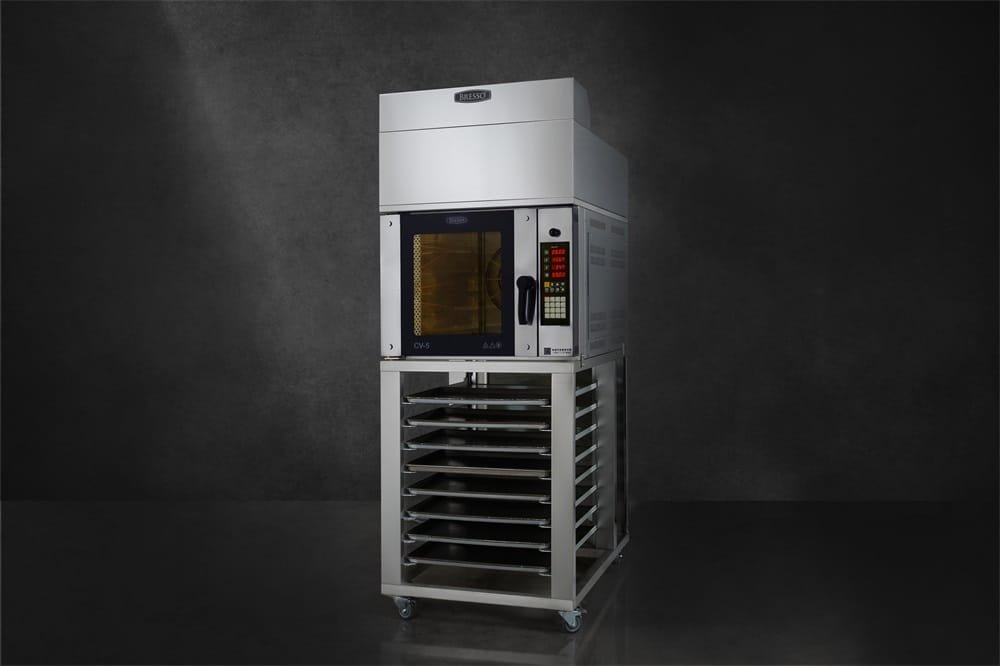
HCV-5 and HCV-10
Two tray capacities are currently listed: five trays for HCV-5 and ten trays for HCV-10. The data below reproduces the main published fields for comparison; confirm every final value on the model quotation, technical sheet and approved drawing.
| Published field | HCV-5 | HCV-10 |
|---|---|---|
| Tray format | 600 × 400 mm | 600 × 400 mm |
| Tray quantity | 5 trays / 5 layers | 10 trays / 10 layers |
| Product size | 780 × 1140 × 610 mm | 780 × 1140 × 1070 mm |
| Power | 9.5 kW | 19 kW |
| Voltage | 380 V or customized | 380 V or customized |
| Temperature field on source page | “Indoor–300°C” | “Indoor–300°C” |
| Steam | Listed | Listed |
| Water connection | Water pipe required | Water pipe required |
| Insert rack | Optional | Optional |
Specification note: The source page’s temperature wording should be clarified in the final technical document. Customized voltage does not mean every voltage/phase combination is automatically available. Ask BRESSO to confirm the exact electrical configuration, current draw, cable protection, water specification, drainage, clearances and compliance documents for the destination.
Watch the HCV convection oven video
Commissioning and product-testing checklist
Installation completion does not prove that a recipe is ready for production. A structured commissioning test gives operators a repeatable starting point and gives the supplier useful evidence if adjustment is needed.
Record these items during the test
- Exact product name, piece weight, pieces per tray and number of loaded trays
- Pan material, tray size, tray spacing and rack positions used
- Preheat setpoint and how readiness was confirmed
- Bake temperature and time by stage
- Fan speed or reversal setting, if adjustable
- Steam timing and quantity setting, if used
- Door-opening time and recovery between batches
- Photos of the top, bottom and centre products on every tray
- Any color, volume, crust or moisture difference by rack position
Change one major variable at a time. If temperature, fan and steam are all changed together, the team cannot identify which adjustment produced the result. Once an acceptable profile is established, save the recipe where the control system allows and keep a written production record.
What distributors and project buyers should request
A professional quotation should be detailed enough for both commercial comparison and technical review. Before comparing suppliers, request the same information from each one.
Application data
- Products, recipes and target finish
- Tray format and pieces per tray
- Required batches or output per shift
- Steam and fan-control requirements
Site data
- Voltage, frequency, phase and available load
- Water, drainage and ventilation
- Room and delivery-route measurements
- Destination country and installation city
Supplier documents
- Model-specific quotation and technical sheet
- Overall and connection drawings
- Applicable compliance documents
- Packing size, weight and shipping terms
Support scope
- Installation and commissioning responsibility
- Operator and maintenance training
- Recommended spare parts
- Warranty terms for the quoted configuration
Convection oven FAQs
What does a convection oven do?
It uses a fan to circulate heated air through the chamber. In bakery production, the moving air increases convective heat transfer around exposed product surfaces and can support multi-tray baking when the airflow, recipe and load are properly matched.
Is a convection oven better than a conventional oven?
Not for every product. Convection is useful when moving air and multi-tray exposure support the desired result. A conventional or deck-style environment may be preferable for products that need calmer air, stronger bottom heat or more independent top-and-bottom control.
Can a convection oven bake bread?
Yes, many breads and rolls can be baked in convection ovens, especially when the fan behavior and steam system match the formula. Artisan products that rely heavily on deck heat may be better evaluated in a deck oven. Test the intended product at the intended load.
Do commercial convection ovens need steam?
Steam is product-dependent. It can be useful for selected breads and rolls but is not required for every cookie, cake, pie or pastry. A steam-equipped model may require water, drainage and water-quality planning even if steam is used for only part of the menu.
How many trays should a bakery convection oven hold?
Choose tray quantity from required batch output, product spacing, bake time, handling time and available utility load. Five or ten trays may suit different operations, but tray count alone cannot determine hourly production.
Should I reduce temperature when converting a recipe to convection?
Some recipes need a lower temperature or shorter time because moving air changes surface heat transfer. There is no universal commercial conversion for every product and oven. Use the recipe developer’s guidance, run a controlled trial and document the result.
Is an air fryer the same as a convection oven?
An air fryer uses a related hot-air principle, but it is generally designed for small consumer batches. A commercial bakery convection oven is specified around professional trays, production duty, utilities, cleaning and service access.
What should I send BRESSO for a convection oven recommendation?
Send the product list, piece weight, tray dimensions, pieces per tray, target output, local voltage/frequency/phase, available power, water and drainage details, room dimensions, delivery access and destination country. Photos or video of the current product are also useful.
Request a convection oven recommendation
Tell BRESSO what you bake, your tray format, the required batch or shift output, available utilities and destination. The team can then discuss whether a tray convection oven, deck oven, combination system or rotary oven is the better starting point.
For an accurate inquiry, include: products, piece weight, tray dimensions, pieces per tray, trays per batch, target output, voltage/frequency/phase, water and drainage, room measurements, destination country and delivery timeline.
Source and verification notes: Product features and specifications were checked against the BRESSO HCV Convection Oven page. General operating explanations were cross-checked with Whirlpool’s convection vs conventional oven guide. Buyers evaluating certified energy performance can review the ENERGY STAR commercial ovens program; its category averages must not be applied to a BRESSO model unless that exact model is listed and documented. Final equipment selection and installation must follow the exact quotation, technical sheet, approved drawing and local requirements.