
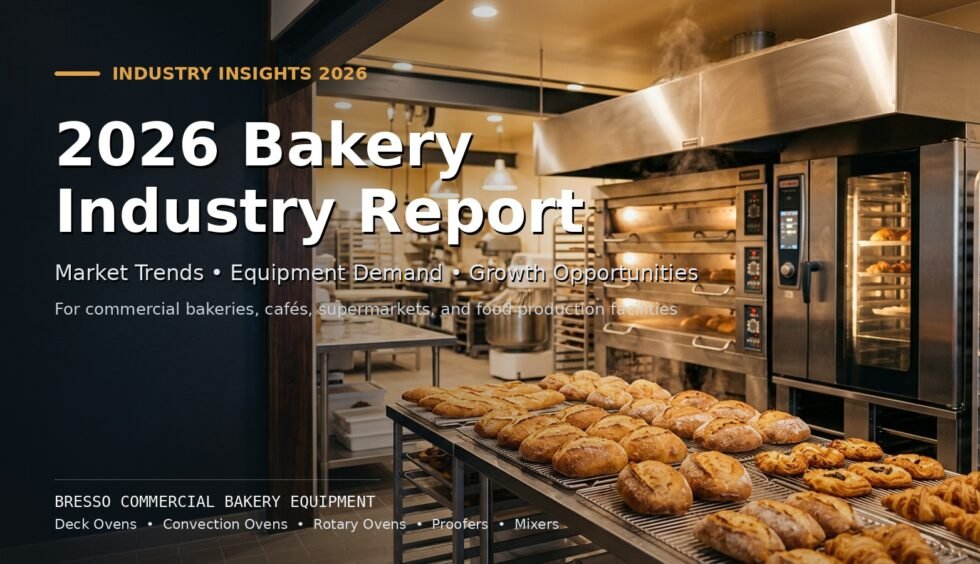
The bakery industry in 2026 is not slowing down. It is changing shape.
For years, growth in the bakery sector was driven by new store openings, premium pastries, social-media-friendly products, and the rising popularity of Western-style baked goods in emerging markets. Those factors still matter, but the next stage of competition is more practical: consistency, efficiency, product quality, labor control, and smart equipment investment.
Bakery owners are no longer buying ovens, proofers, mixers, and dough machines only to “start production.” They are investing in equipment that can help them reduce labor pressure, improve product consistency, save energy, expand capacity, and support long-term business growth.
This report looks at the major bakery industry trends in 2026 and explains how commercial bakery equipment is becoming a key part of bakery business strategy.
For bakeries, cafes, supermarkets, hotel kitchens, and food factories planning equipment upgrades, Bresso offers a full range of commercial bakery equipment, including deck ovens, convection ovens, rotary ovens, proofers, mixers, pastry machines, and refrigeration solutions.
Bakery Market Outlook in 2026
The global bakery market remains one of the largest and most resilient categories in the food industry. Bread, cakes, pastries, cookies, and other baked goods continue to benefit from daily consumption habits, convenience demand, foodservice expansion, and premium product development.
According to Straits Research, the global bakery products market is estimated to reach USD 526.4 billion in 2026, with continued growth expected through 2034 4. IBISWorld also estimates the global bakery goods manufacturing industry at USD 466.4 billion in 2026, with around 131,000 businesses operating worldwide 5.
The equipment side of the industry is also expanding. Research and Markets estimates the commercial baking equipment market at USD 19.35 billion in 2026, with projected growth to USD 28.69 billion by 2032 3. The bakery processing equipment market is also expected to grow from USD 15.97 billion in 2026 to USD 21.08 billion by 2030, driven by automation, energy-efficient equipment, smart ovens, proofers, and scalable production systems 3.
These figures point to a clear direction: demand for baked goods is still growing, but bakeries need better production systems to stay profitable.
1. Freshly Baked Products Are Still Winning
Consumers continue to prefer products that look, smell, and taste freshly baked. This is especially true for bread, croissants, soft rolls, cookies, pizzas, and artisan-style products.
Fresh-baked retail formats are growing in many markets, including neighborhood bakeries, supermarket bakery sections, coffee-and-bakery stores, hotel bakeries, and convenience store bake-off counters. In China, industry reports describe the market as moving toward “fresh baking, national-style bakery products, and channel integration,” with in-store baking becoming one of the faster-growing segments 1.
For bakery operators, this means equipment must support both quality and speed. A store may need to bake several batches throughout the day instead of producing everything in the morning. Ovens need to recover heat quickly, provide stable temperature control, and produce consistent results even during peak hours.
For bakeries focused on bread, pizza, sourdough, and European-style products, a commercial deck oven such as the Bakery Deck Oven HBDO or European W Deck Oven HBWO is often a strong choice. For cookies, cakes, pastries, small breads, and cafe menus, a convection oven can provide efficient and even baking in a compact footprint.
2. Healthier Bakery Products Are Moving From Niche to Mainstream
Health is no longer a small trend in bakery. It is becoming a regular part of product development.
Consumers are paying more attention to sugar levels, fat content, whole grains, natural ingredients, clean labels, plant-based options, and digestive wellness. Straits Research notes that market growth will be supported by demand for high-fiber, low-sugar, clean-label, plant-based, and premium bakery products 4. The artisan bakery market is also seeing stronger demand for gluten-free, organic, low-sugar, and health-conscious baked goods 1.
For bakeries, healthier products are not always easier to make. Whole-grain bread, low-sugar toast, gluten-free items, sourdough, and high-hydration doughs often require better process control. Mixing time, dough temperature, fermentation, steam, bottom heat, and baking curves all influence the final result.
This is one reason many bakeries are upgrading from basic ovens to more stable commercial bakery ovens. A good oven does not only bake the product. It helps control crust, volume, color, moisture, and shelf life.
3. Artisan Bakery Is Growing, But It Needs Reliable Equipment
Artisan bakery continues to attract customers who want better texture, better ingredients, and more distinctive products. Sourdough, baguettes, ciabatta, croissants, Danish pastries, bagels, focaccia, and premium cakes are now common products in many modern bakeries.
The global artisan bakery market is estimated at USD 13.51 billion in 2026 and is expected to grow at a CAGR of 7.8% through 2033 1.
Although the word “artisan” suggests handcraft, successful artisan bakeries still rely heavily on professional equipment. Skilled bakers need tools that can repeat good results every day.
For example:
- Sourdough, baguettes, and European bread need strong bottom heat and steam.
- Croissants and Danish pastries need dough sheeters and controlled refrigeration.
- Cakes, cookies, and choux pastry need even heat circulation.
- High-volume bread production needs consistent baking across every tray.
This is why many bakeries combine several types of equipment instead of relying on one machine. A typical artisan bakery may use a deck oven, dough mixer, refrigerated proofer, dough sheeter, and refrigeration system together.
Bresso’s Spiral / Kneading / Dough Mixer, Sheeter / Pastry Machine, and HBDC Refrigerated Proofer are designed for bakeries that need better control over dough preparation, fermentation, and pastry production.
4. Frozen Dough and Bake-Off Models Are Reshaping Bakery Operations
One of the biggest changes in the bakery industry is the growth of frozen dough, par-baked bread, and centralized production.
For chain bakeries, supermarkets, convenience stores, and foodservice operators, the model is simple: produce or purchase semi-finished bakery products from a central facility, then finish baking in-store. This allows businesses to reduce labor requirements, improve consistency, and serve fresh products throughout the day.
Chinese bakery market reports also show that frozen dough and semi-finished bakery products are growing quickly as chain bakeries and supermarket bake-off models expand 1. Another industry report notes that frozen dough is supporting the transition toward a “central kitchen + simplified store operation” model 2.
This shift changes the way equipment is selected.
A central kitchen needs high-capacity mixers, proofing systems, refrigeration, and large ovens. A retail store needs compact but reliable ovens, refrigerated proofers, and easy operating programs so staff can bake products with less technical training.
For this model, equipment consistency is critical. If each store uses different ovens or different baking settings, the final product will vary. Standardized ovens and proofers help brands keep the same taste, color, and texture across multiple locations.
5. Automation Is Becoming a Practical Solution, Not a Luxury
Labor is one of the biggest challenges for bakeries in 2026. Skilled bakers are harder to find, training takes time, and staff turnover can affect product quality.
This is why automation is becoming more important, even for small and medium-sized bakeries. Automation does not always mean a fully automatic industrial line. It can also mean programmable ovens, controlled proofers, consistent mixers, better temperature control, and equipment that reduces manual guesswork.
The bakery processing equipment market is seeing growth from automated baking lines, smart ovens and proofers, modular equipment, high-throughput dough processing, and hygienic designs 3.
For a bakery business, automation can help in several ways:
- Reduce dependence on one highly skilled baker
- Improve batch-to-batch consistency
- Shorten training time for new staff
- Reduce waste caused by overbaking or underbaking
- Support higher production volume
- Make multi-store expansion easier
As bakery businesses expand, the ability to repeat the same product every day becomes more valuable than ever.
6. Energy Efficiency Is Now Part of Profitability
Energy cost is a serious concern for bakery operators. Ovens, proofers, mixers, refrigerators, and freezers all consume power, and bakeries often run equipment for long hours every day.
A cheaper oven may not be cheaper in the long run if it loses heat quickly, recovers slowly, or requires longer baking times. On the other hand, a well-built commercial oven can help reduce operating cost through better insulation, stable temperature control, efficient heat transfer, and proper capacity matching.
When choosing bakery equipment in 2026, operators should consider the total cost of ownership, not only the purchase price.
Important questions include:
- How many trays can the oven bake per batch?
- How quickly does it recover temperature after loading?
- Is the heat distribution even?
- Does it reduce product loss and rework?
- How easy is it to clean and maintain?
- Are spare parts and service support available?
- Can the same equipment be used when the business expands?
For high-volume bakeries, supermarkets, and central kitchens, a rotary oven can be a practical option because it supports larger batch production and consistent baking results.
Equipment Recommendations by Bakery Type
Different bakery businesses need different equipment combinations. The best choice depends on product type, store size, production volume, labor level, and expansion plan.
Neighborhood Bakery
A neighborhood bakery usually needs flexible equipment for bread, cakes, cookies, pastries, and seasonal products.
Recommended equipment:
- Deck oven or convection oven
- Small or medium proofer
- Spiral mixer or planetary mixer
- Refrigeration equipment
- Basic dough handling tools
A deck oven is suitable for bread, pizza, sourdough, and European-style baked goods. A convection oven is more suitable for cakes, cookies, pastries, and small breads.
Cafe Bakery
Cafe bakeries usually have limited space and need equipment that supports a mixed menu.
Recommended equipment:
- Compact convection oven
- Small deck oven
- Refrigerated storage
- Planetary mixer
- Under-counter refrigerator or freezer
For cafes serving croissants, cookies, cakes, sandwiches, and light meals, a compact baking setup can help improve revenue without requiring a large production area.
Chain Ba kery Store
Chain bakeries need consistent product quality across multiple locations.
Recommended equipment:
- Rotary oven or deck oven
- Refrigerated proofer
- Spiral mixer
- Dough sheeter
- Standardized baking programs
For chain stores, equipment should be easy to operate and easy to replicate. A strong equipment standard makes training, maintenance, and product control much easier.
Supermarket Bakery
Supermarket bakeries need frequent production, strong display appeal, and reliable output during busy hours.
Recommended equipment:
- Rotary oven
- Convection oven
- Refrigerated proofer
- Refrigeration and display equipment
- Bake-off production system
The supermarket bakery model works well with frozen dough, par-baked bread, and central production support.
Central Kitchen and Food Factory
Central kitchens and food factories focus on capacity, efficiency, hygiene, and standardization.
Recommended equipment:
- High-capacity mixers
- Rotary ovens or production ovens
- Large proofing systems
- Dough processing equipment
- Refrigeration and freezing systems
For these operations, the key is not just one machine. The whole production line must work together.
How to Choose Commercial Bakery Equipment in 2026
Before buying bakery equipment, operators should define the business model clearly. A bakery that mainly sells sourdough needs different equipment from a store that sells cakes and cookies. A single cafe needs a different setup from a chain bakery or central kitchen.
Here are the most important factors to review:
Product Type
Bread, cakes, pastries, cookies, pizza, mooncakes, and frozen dough products all require different baking conditions. The equipment should match the product, not the other way around.
Production Volume
A small store may need flexibility. A large bakery needs capacity. Buying equipment that is too small can limit sales, while buying equipment that is too large can waste space and energy.
Temperature Control
Stable temperature is essential for consistent results. Good ovens provide reliable heat distribution, accurate control, and fast recovery after loading.
Steam and Humidity
Steam is important for many bread products, especially baguettes, sourdough, and European-style bread. Proofing humidity is also important for dough quality.
Labor Skill Level
If the store relies on less experienced staff, programmable controls and stable equipment become more important.
Energy Consumption
Energy-efficient equipment can reduce long-term operating costs, especially for stores that bake several times per day.
Maintenance and Service
Commercial bakery equipment should be easy to clean, maintain, and repair. Reliable after-sales support is an important part of the buying decision.
The Future of Bakery: Better Products, Better Systems
The bakery industry in 2026 is full of opportunity, but it is also more competitive than before.
Customers want fresher products, healthier choices, better texture, and more interesting flavors. At the same time, bakery operators must control labor, energy, rent, and ingredient costs. This puts pressure on businesses to improve both product development and production efficiency.
The bakeries that grow in the next few years will likely have three strengths:
- Clear product positioning
- Reliable production systems
- Equipment that supports consistency and expansion
Commercial bakery equipment is no longer just a basic purchase. It is part of the business model.
Whether you are opening a new bakery, upgrading an existing store, building a supermarket bakery section, or planning a central kitchen, choosing the right oven, proofer, mixer, and dough processing equipment can directly affect product quality and profitability.
Explore Bresso’s full range of commercial bakery ovens and bakery equipment to find suitable solutions for your production needs.
FAQ
1. What are the main bakery industry trends in 2026?
The main trends include fresh-baked retail formats, healthier bakery products, artisan bread and pastry demand, frozen dough and bake-off models, automation, energy efficiency, and commercial equipment upgrades.
2. Is the bakery industry still growing in 2026?
Yes. Global bakery demand remains strong, supported by daily consumption, convenience needs, premium products, supermarket bakery sections, cafe bakery formats, and foodservice expansion.
3. What type of oven is best for a bakery?
It depends on the product. Deck ovens are suitable for bread, pizza, sourdough, and European-style products. Convection ovens are suitable for cakes, cookies, pastries, and small breads. Rotary ovens are suitable for high-volume production.
4. Why do bakeries use refrigerated proofers?
Refrigerated proofers help control fermentation time and dough quality. They are useful for overnight fermentation, frozen dough recovery, and early-morning production planning.
5. What equipment does a small bakery need?
A small bakery usually needs a commercial oven, dough mixer, proofer, refrigeration equipment, worktable, and basic dough handling tools. Product type and daily production volume should determine the exact setup.
6. Why is commercial bakery equipment important for chain bakeries?
Chain bakeries need consistent products across different stores. Standardized ovens, proofers, mixers, and baking programs help reduce product variation and make staff training easier.
7. How can bakeries reduce labor pressure?
Bakeries can reduce labor pressure by using programmable ovens, controlled proofers, efficient mixers, dough sheeters, frozen dough systems, and standardized production procedures.
8. Where can I buy commercial bakery equipment?
You can explore Bresso’s commercial bakery equipment range here: https://bresso-oven.com/products/